实例如下:
# -*- coding:utf-8 -*-

from numpy import *
import numpy as np
import pandas as pd
from math import log
import operator

#计算数据集的香农熵
def calcShannonEnt(dataSet):
 numEntries=len(dataSet)
 labelCounts={}
 #给所有可能分类创建字典
 for featVec in dataSet:
 currentLabel=featVec[-1]
 if currentLabel not in labelCounts.keys():
 labelCounts[currentLabel]=0
 labelCounts[currentLabel]+=1
 shannonEnt=0.0
 #以2为底数计算香农熵
 for key in labelCounts:
 prob = float(labelCounts[key])/numEntries
 shannonEnt-=prob*log(prob,2)
 return shannonEnt


#对离散变量划分数据集,取出该特征取值为value的所有样本
def splitDataSet(dataSet,axis,value):
 retDataSet=[]
 for featVec in dataSet:
 if featVec[axis]==value:
 reducedFeatVec=featVec[:axis]
 reducedFeatVec.extend(featVec[axis+1:])
 retDataSet.append(reducedFeatVec)
 return retDataSet

#对连续变量划分数据集,direction规定划分的方向,
#决定是划分出小于value的数据样本还是大于value的数据样本集
def splitContinuousDataSet(dataSet,axis,value,direction):
 retDataSet=[]
 for featVec in dataSet:
 if direction==0:
 if featVec[axis]>value:
 reducedFeatVec=featVec[:axis]
 reducedFeatVec.extend(featVec[axis+1:])
 retDataSet.append(reducedFeatVec)
 else:
 if featVec[axis]<=value:
 reducedFeatVec=featVec[:axis]
 reducedFeatVec.extend(featVec[axis+1:])
 retDataSet.append(reducedFeatVec)
 return retDataSet

#选择最好的数据集划分方式
def chooseBestFeatureToSplit(dataSet,labels):
 numFeatures=len(dataSet[0])-1
 baseEntropy=calcShannonEnt(dataSet)
 bestInfoGain=0.0
 bestFeature=-1
 bestSplitDict={}
 for i in range(numFeatures):
 featList=[example[i] for example in dataSet]
 #对连续型特征进行处理
 if type(featList[0]).__name__=='float' or type(featList[0]).__name__=='int':
 #产生n-1个候选划分点
 sortfeatList=sorted(featList)
 splitList=[]
 for j in range(len(sortfeatList)-1):
 splitList.append((sortfeatList[j]+sortfeatList[j+1])/2.0)

 bestSplitEntropy=10000
 slen=len(splitList)
 #求用第j个候选划分点划分时,得到的信息熵,并记录最佳划分点
 for j in range(slen):
 value=splitList[j]
 newEntropy=0.0
 subDataSet0=splitContinuousDataSet(dataSet,i,value,0)
 subDataSet1=splitContinuousDataSet(dataSet,i,value,1)
 prob0=len(subDataSet0)/float(len(dataSet))
 newEntropy+=prob0*calcShannonEnt(subDataSet0)
 prob1=len(subDataSet1)/float(len(dataSet))
 newEntropy+=prob1*calcShannonEnt(subDataSet1)
 if newEntropy<bestSplitEntropy:
 bestSplitEntropy=newEntropy
 bestSplit=j
 #用字典记录当前特征的最佳划分点
 bestSplitDict[labels[i]]=splitList[bestSplit]
 infoGain=baseEntropy-bestSplitEntropy
 #对离散型特征进行处理
 else:
 uniqueVals=set(featList)
 newEntropy=0.0
 #计算该特征下每种划分的信息熵
 for value in uniqueVals:
 subDataSet=splitDataSet(dataSet,i,value)
 prob=len(subDataSet)/float(len(dataSet))
 newEntropy+=prob*calcShannonEnt(subDataSet)
 infoGain=baseEntropy-newEntropy
 if infoGain>bestInfoGain:
 bestInfoGain=infoGain
 bestFeature=i
 #若当前节点的最佳划分特征为连续特征,则将其以之前记录的划分点为界进行二值化处理
 #即是否小于等于bestSplitValue
 if type(dataSet[0][bestFeature]).__name__=='float' or type(dataSet[0][bestFeature]).__name__=='int':
 bestSplitValue=bestSplitDict[labels[bestFeature]]
 labels[bestFeature]=labels[bestFeature]+'<='+str(bestSplitValue)
 for i in range(shape(dataSet)[0]):
 if dataSet[i][bestFeature]<=bestSplitValue:
 dataSet[i][bestFeature]=1
 else:
 dataSet[i][bestFeature]=0
 return bestFeature

#特征若已经划分完,节点下的样本还没有统一取值,则需要进行投票
def majorityCnt(classList):
 classCount={}
 for vote in classList:
 if vote not in classCount.keys():
 classCount[vote]=0
 classCount[vote]+=1
 return max(classCount)

#主程序,递归产生决策树
def createTree(dataSet,labels,data_full,labels_full):
 classList=[example[-1] for example in dataSet]
 if classList.count(classList[0])==len(classList):
 return classList[0]
 if len(dataSet[0])==1:
 return majorityCnt(classList)
 bestFeat=chooseBestFeatureToSplit(dataSet,labels)
 bestFeatLabel=labels[bestFeat]
 myTree={bestFeatLabel:{}}
 featValues=[example[bestFeat] for example in dataSet]
 uniqueVals=set(featValues)
 if type(dataSet[0][bestFeat]).__name__=='str':
 currentlabel=labels_full.index(labels[bestFeat])
 featValuesFull=[example[currentlabel] for example in data_full]
 uniqueValsFull=set(featValuesFull)
 del(labels[bestFeat])
 #针对bestFeat的每个取值,划分出一个子树。
 for value in uniqueVals:
 subLabels=labels[:]
 if type(dataSet[0][bestFeat]).__name__=='str':
 uniqueValsFull.remove(value)
 myTree[bestFeatLabel][value]=createTree(splitDataSet\
 (dataSet,bestFeat,value),subLabels,data_full,labels_full)
 if type(dataSet[0][bestFeat]).__name__=='str':
 for value in uniqueValsFull:
 myTree[bestFeatLabel][value]=majorityCnt(classList)
 return myTree

import matplotlib.pyplot as plt
decisionNode=dict(boxstyle="sawtooth",fc="0.8")
leafNode=dict(boxstyle="round4",fc="0.8")
arrow_args=dict(arrowstyle="<-")


#计算树的叶子节点数量
def getNumLeafs(myTree):
 numLeafs=0
 firstSides = list(myTree.keys())
 firstStr=firstSides[0]
 secondDict=myTree[firstStr]
 for key in secondDict.keys():
 if type(secondDict[key]).__name__=='dict':
 numLeafs+=getNumLeafs(secondDict[key])
 else: numLeafs+=1
 return numLeafs

#计算树的最大深度
def getTreeDepth(myTree):
 maxDepth=0
 firstSides = list(myTree.keys())
 firstStr=firstSides[0]
 secondDict=myTree[firstStr]
 for key in secondDict.keys():
 if type(secondDict[key]).__name__=='dict':
 thisDepth=1+getTreeDepth(secondDict[key])
 else: thisDepth=1
 if thisDepth>maxDepth:
 maxDepth=thisDepth
 return maxDepth

#画节点
def plotNode(nodeTxt,centerPt,parentPt,nodeType):
 createPlot.ax1.annotate(nodeTxt,xy=parentPt,xycoords='axes fraction',\
 xytext=centerPt,textcoords='axes fraction',va="center", ha="center",\
 bbox=nodeType,arrowprops=arrow_args)

#画箭头上的文字
def plotMidText(cntrPt,parentPt,txtString):
 lens=len(txtString)
 xMid=(parentPt[0]+cntrPt[0])/2.0-lens*0.002
 yMid=(parentPt[1]+cntrPt[1])/2.0
 createPlot.ax1.text(xMid,yMid,txtString)

def plotTree(myTree,parentPt,nodeTxt):
 numLeafs=getNumLeafs(myTree)
 depth=getTreeDepth(myTree)
 firstSides = list(myTree.keys())
 firstStr=firstSides[0]
 cntrPt=(plotTree.x0ff+(1.0+float(numLeafs))/2.0/plotTree.totalW,plotTree.y0ff)
 plotMidText(cntrPt,parentPt,nodeTxt)
 plotNode(firstStr,cntrPt,parentPt,decisionNode)
 secondDict=myTree[firstStr]
 plotTree.y0ff=plotTree.y0ff-1.0/plotTree.totalD
 for key in secondDict.keys():
 if type(secondDict[key]).__name__=='dict':
 plotTree(secondDict[key],cntrPt,str(key))
 else:
 plotTree.x0ff=plotTree.x0ff+1.0/plotTree.totalW
 plotNode(secondDict[key],(plotTree.x0ff,plotTree.y0ff),cntrPt,leafNode)
 plotMidText((plotTree.x0ff,plotTree.y0ff),cntrPt,str(key))
 plotTree.y0ff=plotTree.y0ff+1.0/plotTree.totalD

def createPlot(inTree):
 fig=plt.figure(1,facecolor='white')
 fig.clf()
 axprops=dict(xticks=[],yticks=[])
 createPlot.ax1=plt.subplot(111,frameon=False,**axprops)
 plotTree.totalW=float(getNumLeafs(inTree))
 plotTree.totalD=float(getTreeDepth(inTree))
 plotTree.x0ff=-0.5/plotTree.totalW
 plotTree.y0ff=1.0
 plotTree(inTree,(0.5,1.0),'')
 plt.show()

df=pd.read_csv('watermelon_4_3.csv')
data=df.values[:,1:].tolist()
data_full=data[:]
labels=df.columns.values[1:-1].tolist()
labels_full=labels[:]
myTree=createTree(data,labels,data_full,labels_full)
print(myTree)
createPlot(myTree)
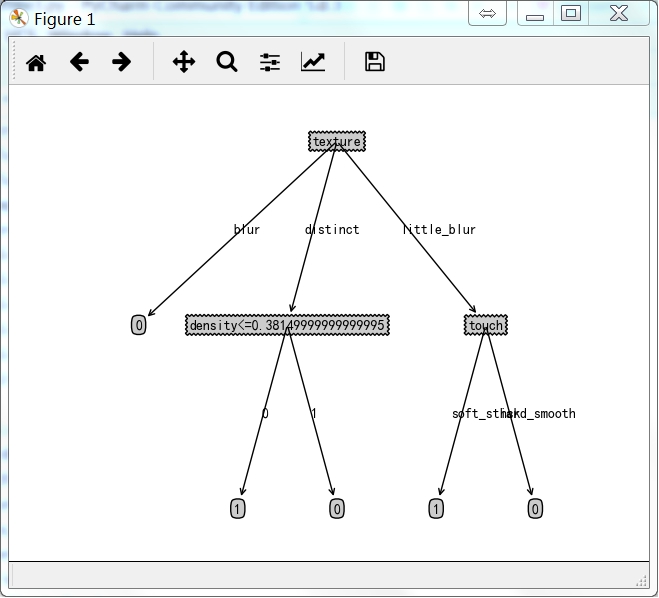
最终结果如下:
{'texture': {'blur': 0, 'little_blur': {'touch': {'soft_stick': 1, 'hard_smooth': 0}}, 'distinct': {'density<=0.38149999999999995': {0: 1, 1: 0}}}}
得到的决策树如下:
参考资料:
《机器学习实战》
《机器学习》周志华著
以上这篇基于ID3决策树算法的实现(Python版)就是小编分享给大家的全部内容了,希望能给大家一个参考,也希望大家多多支持脚本之家。